
|
Quantity
|
Out of stock
|
||
|
|
|||
|
|
|||
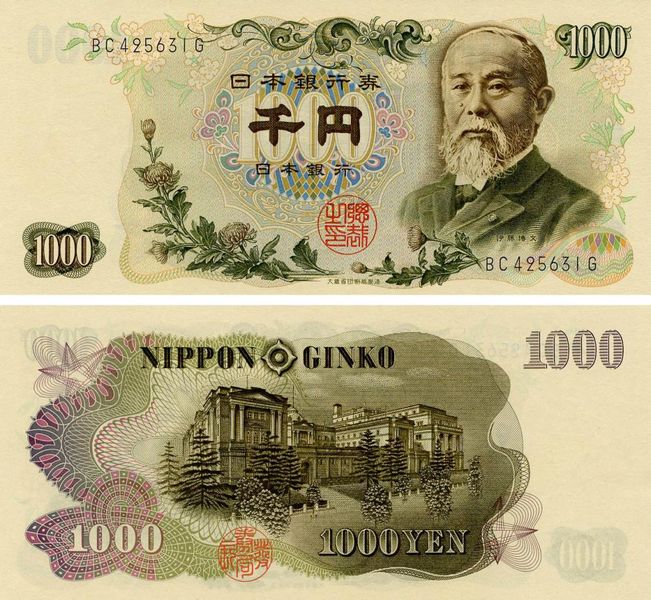
The bank states outright that notes withdrawn from issue are now rarely seen and that cash-handling machines no longer take them, but that the head office and branches of the Bank of Japan exchange them — undamaged ones included — for current money. The Ito Hirobumi thousand is the longest valid thousand: 164 mm against 150 mm for the current notes, so its length alone gives it away.
On the face the bank names a portrait of Ito Hirobumi. A note of the Bank of Japan. The bank first issued it on 1 November 1963 for the black serial, with blue-serial notes following on 1 July 1976. Issuance stopped on 4 January 1986. Stopping issuance does not end the note's validity: the bank states that of the 56 kinds of banknote it has issued since 1885, 25 remain valid, and that a note once issued loses its force only through a special legal measure — there have been three, the clearing of notes burnt in the Great Kanto Earthquake (1927), the «new yen» changeover (1946) and the clearing of money below one yen (1953). The most interesting security features are a watermark, which the bank makes by varying the thickness of the paper; extremely fine lines in the design — the bank says a colour copier and ordinary printing reproduce such a web poorly; and intaglio printing — the numeral characters and the portrait are printed so that the ink stands above the paper and the surface feels rough.
UNC condition means the note has never circulated: no folds, no wear, no soiling, even corners — just as it left the press.
If this theme interests you, take a look at the other items in the VPcoins catalogue.