
|
Quantity
|
Out of stock
|
||
|
|
|||
|
|
|||
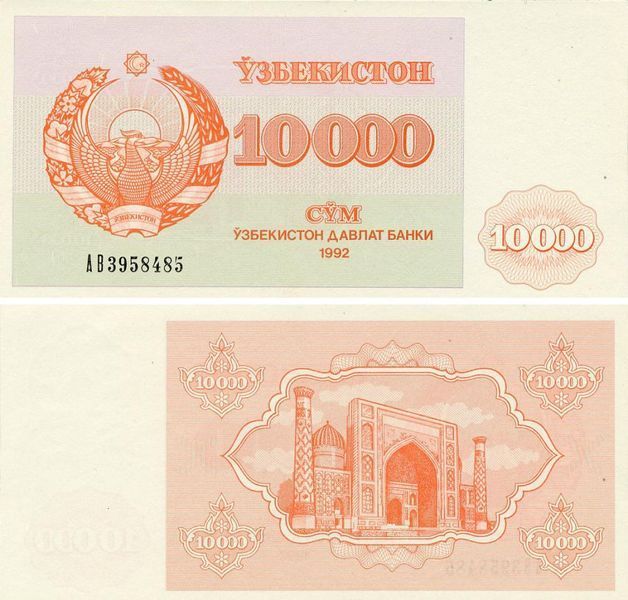
In 1993 Uzbekistan replaced the Soviet ruble with money of its own, the sum, exchanged for rubles at par. This first sum, known to collectors as the «sum-coupon», was issued by the State Bank of Uzbekistan; the 10,000 sum note belongs to this series and is dated 1992, although the sums entered circulation only in 1993.
All denominations of the series share one design. The front shows the state coat of arms of Uzbekistan and the Uzbek Cyrillic lettering «Ozbekiston davlat banki» (State Bank of Uzbekistan). The back shows the Sherdor Madrasa on Registan Square in Samarkand, built in 1619–1635. The Central Bank later returned to this building: the lion carrying the sun from the madrasa’s façade became the design of the 200 sum note of 1997.
Ten thousand sum is the highest value of the series. The first sum was short-lived: on 1 July 1994 it was replaced by the present sum at one thousand old to one new, and the 1992-dated series left circulation.
The 1992 10,000 sum note belongs in an Uzbekistan collection and in a set of post-Soviet money: the sum-coupon series opens the history of the Uzbek currency, and the Sherdor Madrasa links it to today’s notes. UNC condition means the note has never circulated: no folds, no wear, no soiling, even corners — just as it left the press.
More banknotes from this country and this era are waiting in the VPcoins catalogue.