


|
Quantity
|
Out of stock
|
||
|
|
|||
|
|
|||
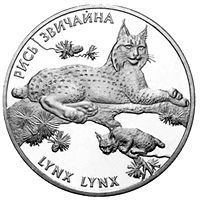
The scientific name Lynx lynx, which runs along the lower edge of this reverse, comes from a Greek word for light — a nod to the animal's legendary eyesight. The ancient Greeks believed a lynx could see through solid objects, and in 1690 the Polish astronomer Johannes Hevelius named a constellation after it, since only a lynx-eyed observer could make out its faint stars.
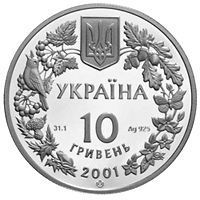
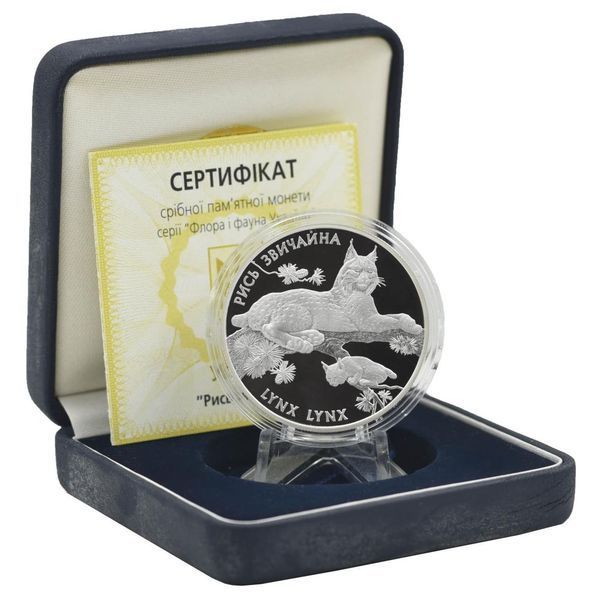
Part of the National Bank of Ukraine's Flora and Fauna series, this 2001 silver 10 hryvnias (KM# 115) shows an adult lynx with a cub on a branch, with РИСЬ ЗВИЧАЙНА above and LYNX LYNX below. The choice reflects the animal's status: the lynx is listed in the Red Book of Ukraine and hunting it is banned. Once common in Polissia, it had become rare there by the 19th century and almost vanished by the early 20th, prized for its spotted fur. The bank now puts Ukraine's population at around 500, roughly 400 of them in the Carpathians.
The bank returned to the species in 2023 with its Chornobyl. Revival. Eurasian Lynx coin; this 2001 silver piece was limited to 3,000.
Proof finish: mirror field with frosted figures.