




|
Quantity
|
Out of stock
|
||
|
|
|||
|
|
|||
Railway tracks forming the letter V and the Crystal Palace: the Victorian age fits onto the 2001 British £5 crown. The coin marks the centenary of the Queen’s death: Victoria died at Osborne House on the Isle of Wight on 22 January 1901 after reigning for almost 64 years, longer than any British monarch before her.
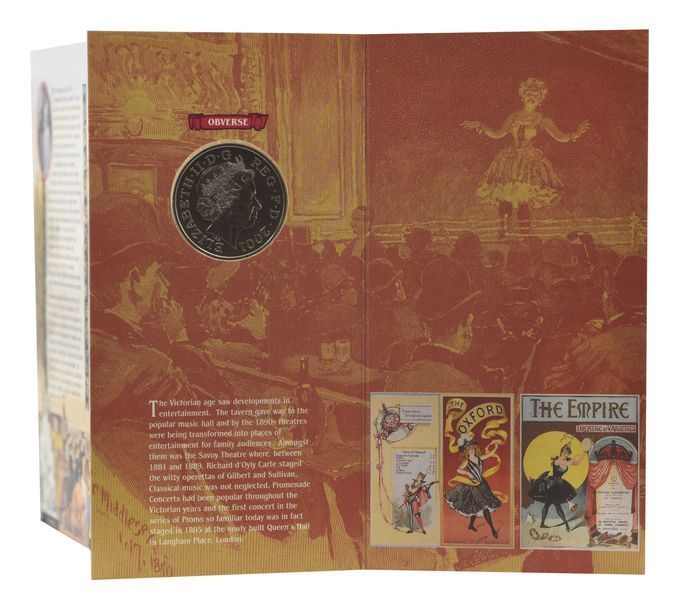
The reverse was created by the sculptor Mary Milner Dickens. Stylised railway lines form a V enclosing Victoria’s profile, familiar from the postage stamps of her time; the Crystal Palace provides the backdrop, and the value FIVE POUNDS frames the composition. The dates 1901 and 2001 appear below. The obverse carries Ian Rank-Broadley’s portrait of Elizabeth II with the legend ELIZABETH II D G REG F D and the date 2001.
Every element of the design is a sign of the era. In 1851 the Crystal Palace in London’s Hyde Park housed the Great Exhibition, the most celebrated project of Prince Albert, the Queen’s husband. The railway also has a personal link with Victoria: on 13 June 1842 she became the first British monarch to travel by train. The designer won the Prix de Rome for Sculpture in 1957, and for the Royal Mint she also created three commemorative 50p coins, including the 2003 issue for the centenary of the Women’s Social and Political Union.
According to the Royal Mint, the standard-finish mintage of this crown was 851,491, the lowest of any £5 crown of 1990–2005. The coin could be obtained at face value but was issued as a commemorative rather than for spending. In a collection it brings two reigning queens together on one coin and belongs in a thematic set on the Victorian age.
Uncirculated (UNC) condition means the coin has never been in circulation: there is no wear, the mint lustre is intact, and only minor marks from storage in bank bags are acceptable. This example comes in a souvenir package.
VPcoins brings coins and banknotes from all over the world together in one catalogue.