




|
Quantity
|
Out of stock
|
||
|
|
|||
|
|
|||
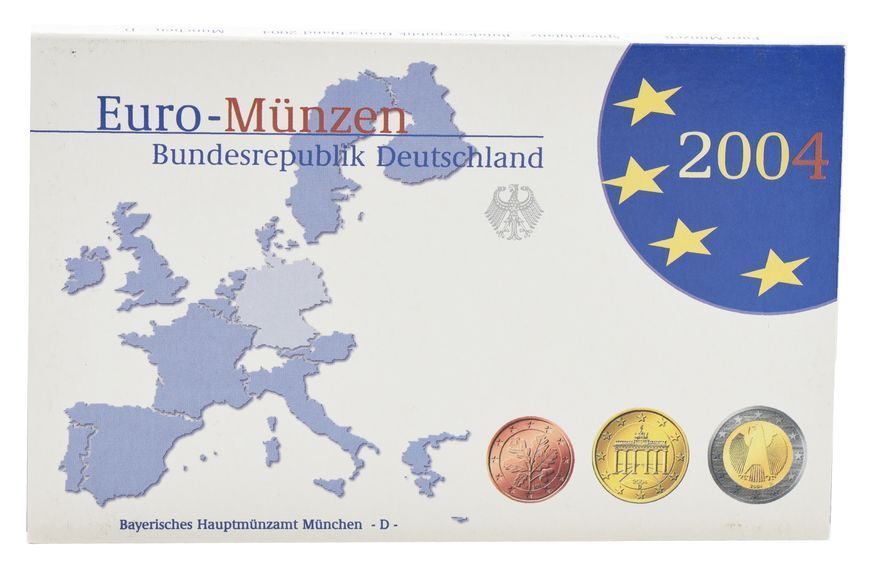
An eagle, the Brandenburg Gate and an oak twig: three German symbols in one set, struck in Munich in 2004. The letter D on each of the eight coins stands for the Bavarian Central Mint (Bayerisches Hauptmünzamt), one of the five mints that produce euro coins for Germany.
Each design carries a meaning. Reinhard Heinsdorff drew the gate on the 10, 20 and 50 cent coins from an angle that stresses its openness, an image of German reunification and European unity. The eagle on the €1 and €2 by Heinz Hoyer and Sneschana Russewa-Hoyer is encircled by the European stars, while Professor Rolf Lederbogen’s oak twig on the 1, 2 and 5 cent coins continues the pfennig tradition.
The date makes the set especially telling: the EU enlarged on 1 May 2004, yet the coins from 10 cents to €2 still bear the common-side map of the 15 states before enlargement. The small coins have a different common side, showing Europe on a globe beside Africa and Asia.
Every German mint issues its own uncirculated set each year, and the Munich set is the essential D position in the 2004 run A, D, F, G, J. The souvenir packaging keeps the set complete.
UNC grade means the coins never circulated: there is no wear, the original mint lustre is intact, and only minor handling marks from storage are possible.
Would you like to complete the whole series? See the other issues in the VPcoins catalogue.