
|
Quantity
|
Out of stock
|
||
|
|
|||
|
|
|||
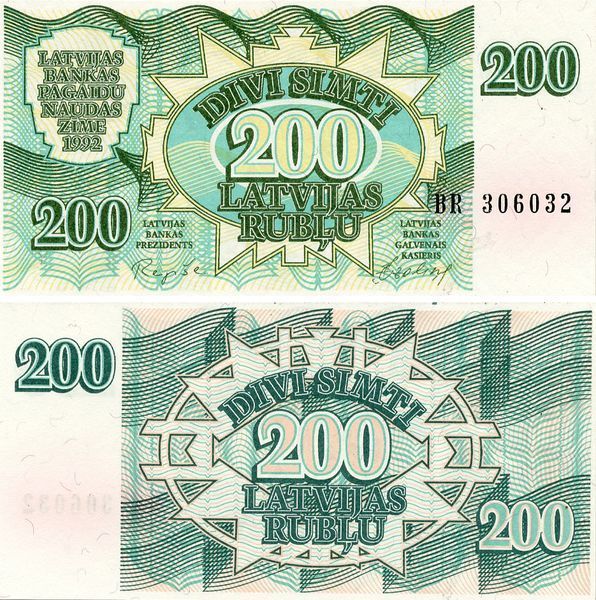
Two hundred Latvian rubļu is money from a time of transition: after restoring its independence Latvia began a currency reform, and from 7 May 1992 the Latvian ruble, a temporary currency of the Bank of Latvia, entered circulation. It ran in parallel with the Soviet ruble and was set equal to it one for one.
The text on the front says it outright: LATVIJAS BANKAS PAGAIDU NAUDAS ZĪME, «temporary money token of the Bank of Latvia», followed by DIVI SIMTI LATVIJAS RUBĻU, «two hundred Latvian rubles». The design is deliberately austere: instead of portraits or landscapes there is a symmetrical ornament, and all denominations share one format, told apart by colour.
«Temporary» proved literal. From 5 March 1993 the rubles were gradually replaced by the lats at 200 rubles to one lats, and on 18 October that year they were withdrawn from circulation. People nicknamed them «repšiki» after Einārs Repše, then president of the Bank of Latvia.
For a Latvia collection it is the link between the Soviet ruble and the lats, money from the brief chapter of 1992–1993, and the second-highest denomination after the 500. UNC condition means the note has never circulated: no folds, no wear, no soiling, even corners — just as it left the press.
The VPcoins catalogue unites coins and banknotes from many countries and eras.