


|
Quantity
|
Out of stock
|
||
|
|
|||
|
|
|||
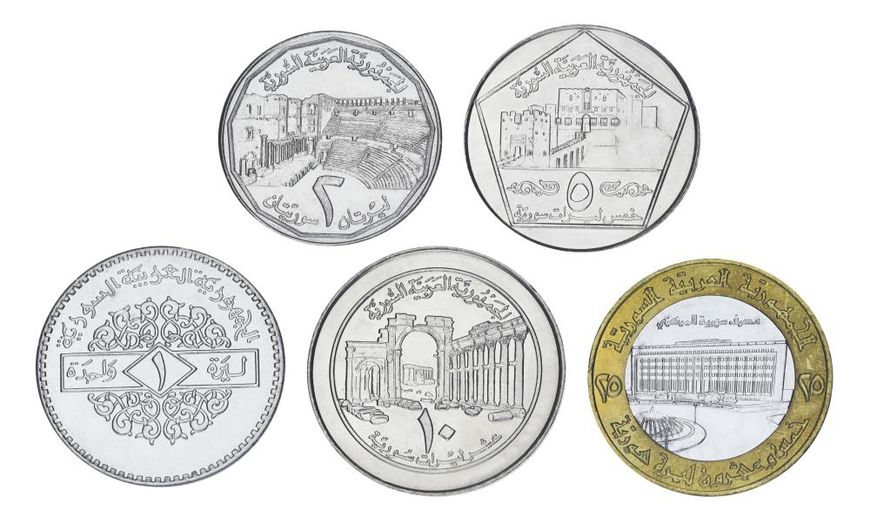
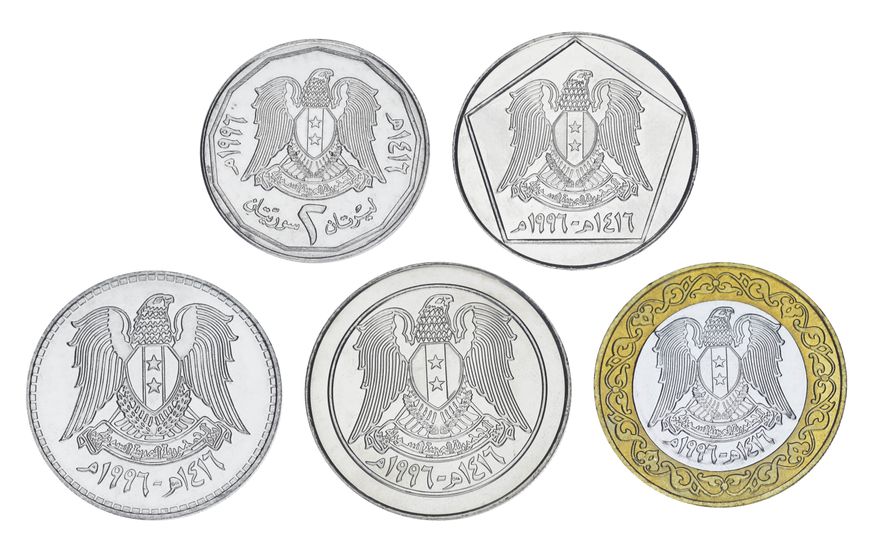
Only five years separate these five coins, yet together they show Syria changing its coinage: a 1 lira of 1991 sits alongside the 2, 5, 10 and 25 pounds of 1996, the issue with which the country renewed its circulating coins after a period of high inflation.
The first thing to catch the eye is the shield on the breast of the Hawk of Quraish, Syria’s coat of arms. On the 1991 lira it carries three stars, on the 1996 coins two, and the difference is plain when the pieces lie side by side. On all five coins the hawk holds a scroll reading «الجمهورية العربية السورية» (Syrian Arab Republic), and the dates follow two calendars, Hijri and Gregorian: 1412 and 1991 on the lira, 1416 and 1996 on the rest.
In 1996 architecture arrived on Syrian coins, with historic monuments replacing ornament. The 2 pounds shows the Roman theatre at Bosra, built of black basalt in the 2nd century and regarded as one of the best preserved theatres of the Roman Empire. The 5 pounds carries the Citadel of Aleppo with its monumental gateway and arched bridge across the moat, a fortress already in use in the 3rd millennium BC. The 10 pounds features the ruins of Palmyra, and the 25 pounds the Central Bank of Syria building with the words «مصرف سورية المركزي».
The highest value in the set, the 25 pounds, is bimetallic, the only such coin in the 1996 Syrian series. For a Syria collection the set captures the switch to a new range of coins and doubles as a small gallery of the country: a Roman theatre, a medieval citadel, ancient Palmyra and the bank that issued the coins themselves.
UNC grade: the coins never circulated, show no wear and keep their mint lustre. With all five in equally fresh condition, the details are easy to compare: the stars on the shield, the architectural scenes and the double dates.
Numismatics begins with a single coin and continues in the VPcoins catalogue.