
|
Quantity
|
Out of stock
|
||
|
|
|||
|
|
|||
The bank explains the idea this way: the series draws its inspiration from the elements that distinctively define the country — traditional art and craft, natural wonders, flora and fauna, the economy and tradition — and the reverse of each denomination shows its own distinctively Malaysian features. The RM50 was issued in July 2009 and the remaining denominations of the series in June 2012.
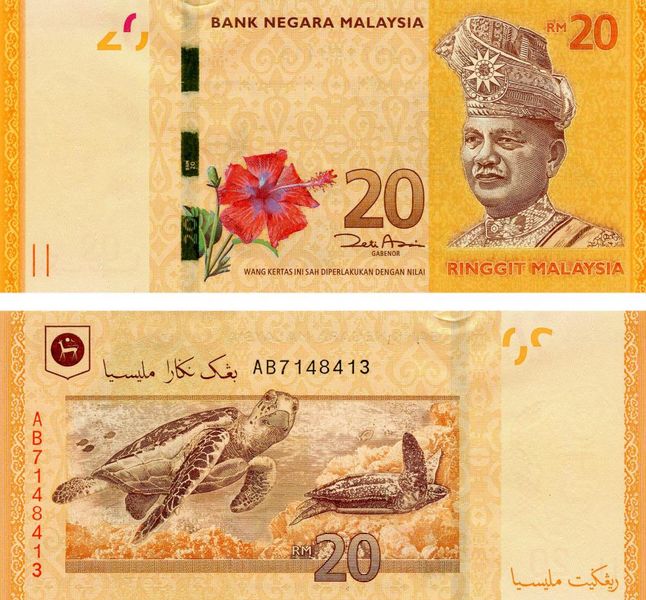
The obverse shows the portrait of the Yang di-Pertuan Agong in intaglio, together with the inscriptions, which are also raised to the touch. The reverse shows two sea turtles native to Malaysian waters — the Hawksbill Turtle (Eretmochelys imbricata) and the Leatherback Turtle (Dermochelys coriacea). The Hawksbill is identified by its curved beak and scaly shell, the Leatherback by its leathery skin and the seven ridges on its shell. The bank calls them ambassadors of the rich and colourful marine life of the tropical waters and a reminder that the existence of these gentle animals rests on the delicate balance between human activity and marine conservation.
A banknote of Bank Negara Malaysia from the fourth series, «Distinctively Malaysia». The most interesting security features are intaglio printing — the portrait of the Agong and the inscriptions are raised and can be felt by touch; perfect see-through register — against the light the figure of the denomination forms completely; and intaglio micro lettering, legible with a magnifier.
The Malaysian ringgit is collected by series: the present fourth series, «Distinctively Malaysia», is one design, the earlier series have their own subjects and sizes, and one and the same denomination of the fourth series is signed by different governors of the bank. UNC condition means the note has never circulated: no folds, no wear, no soiling, even corners — just as it left the press.
If you are just starting a collection, the VPcoins catalogue makes it easy to find banknotes to build it around.